Skip to main content Skip to menu Skip to footer
CWLP Home
Facebook X Instagram About CWLP Contact Us City Of Springfield City Alerts

City Water, Light, and Power

 A Department of the City of Springfield

 Misty Buscher - Mayor  ~  Doug Brown - Chief Utility Engineer

CWLP Home
  •   I Want To...      
      • I Want To...
      • Manage my account...
      • Make a Payment...
      • Report a problem...
      • Find information...
      • Get help with...
      • Sign-up for...


    • Power Out?


      View Outage Information and Map.


    • Job Opportunities


      Current openings at CWLP.

  •   Electric      
      • Electric Division Home
      • Outage Center
      • Electric Generation
      • Electric Distribution
      • Energy Emergency FAQs
      • Electric Rates
      • Electric Safety
      • Trees and Power Lines
      • Renewable Energy
      • Security Lighting
      • Contractor Info


    • Power Out?


      Find out what you should you do.


    • Senior Citizen Discount


      Qualifications for electric rate discount for age 62 and up.

  •   Water      
      • Water Division Home
      • Water Purification
      • Water Quality
      • Water Distribution
      • Water Rates
      • Lead Awareness
      • Water Maintenance
      • Sewer/Sanitary Rates


    • Drinking Water Quality


      See the latest Water Quality Report.


    • Supplemental Water Supply


      Learn about our application for a supplemental water source.

  •   Save Energy - Save Water      
      • Save Energy - Save Water Home
      • Energy Efficiency
      • Water Conservation
      • Rebates
      • Energy Audits & Technical Assistance
      • Renewable Energy
      • Smart Solutions Workshops


    • Heat Pumps


      Learn about heat pumps and the rebate we offer to residential and commercial customers.


    • Ask an Expert


      Let us answer your efficiency questions and help you save money on your bill.

  •   Lake & Parks      
      • Lakes and Parks Home
      • Lake Water Levels
      • Lake Water Quality
      • Lake Activities
      • Park Information


    • Boating


      Find out about boat launches, licensing and more for Lake Springfield.


    • Lake Water Quality


      Check out our water quality statistics.

  •   Customer Service      
      • Customer Service Home
      • Rates
      • Rebates
      • Business Services
      • Account Services
      • Bill Assistance
      • Round-Up Program
      • Senior Citizen Discount
      • CWLP Gift Cards


    • Account FAQs


      Find answers to our most common account questions.


    • Your Account


      Click here to sign into myCWLP.

  •  Pay @myCWLP 
  •   I Want To...      
    • Manage my account...
    • Make a Payment...
    • Report a Problem...
    • Find information...
    • Get help with...
    • Sign-up for...
  •   Electric      
    • Electric Division Home
    • Outage Center
    • Electric Generation
    • Electric Distribution
    • Energy Emergency FAQs
    • Electric Rates
    • Electric Safety
    • Trees and Power Lines
    • Renewable Energy
    • Security Lighting
    • Contractor Info
  •   Water      
    • Water Division Home
    • Water Purification
    • Water Quality
    • Water Distribution
    • Water Rates
    • Lead Awareness
    • Water Maintenance
    • Sewer/Sanitary Rates
  •   Save Energy & Water      
    • Save Energy - Save Water Home
    • Energy Efficiency
    • Water Conservation
    • Rebates
    • Energy Audits & Technical Assistance
    • Renewable Energy
    • Smart Solutions Workshops
  •   Lakes & Parks      
    • Lakes and Parks Home
    • Lake Water Levels
    • Lake Water Quality
    • Lake Activities
    • Park Information
  •   Customer Service      
    • Customer Service Home
    • Rates
    • Rebates
    • Business Services
    • Account Services
    • Bill Assistance
    • Round-Up Program
    • Senior Citizen Discount
    • CWLP Gift Cards
  •  Pay @myCWLP 

  •   I Want To...      
    • Manage my account...
    • Make a Payment...
    • Report a Problem...
    • Find information...
    • Get help with...
    • Sign-up for...
  •   Electric      
    • Electric Division Home
    • Outage Center
    • Electric Generation
    • Electric Distribution
    • Energy Emergency FAQs
    • Electric Rates
    • Electric Safety
    • Trees and Power Lines
    • Renewable Energy
    • Security Lighting
    • Contractor Info
  •   Water      
    • Water Division Home
    • Water Purification
    • Water Quality
    • Water Distribution
    • Water Rates
    • Lead Awareness
    • Water Maintenance
    • Sewer/Sanitary Rates
  •   Save Energy & Water      
    • Save Energy & Water Home
    • Energy Efficiency
    • Water Conservation
    • Rebates
    • Energy Audits & Technical Assistance
    • Renewable Energy
    • Smart Solutions Workshops
  •   Lakes & Parks      
    • Lakes and Parks Home
    • Lake Water Levels
    • Lake Water Quality
    • Lake Activities
    • Park Information
  •   Customer Service      
    • Customer Service Home
    • Rates
    • Rebates
    • Business Services
    • Account Services
    • Bill Assistance
    • Round-Up Program
    • Senior Citizen Discount
    • CWLP Gift Cards
  •  Pay @myCWLP 
Skip Navigation Links

Regional Energy Emergencies


There might be circumstances when demand for electricity on the regional grid outside of CWLP is greater than what can be generated or supplied. Generator outages, weather impacts, transmission trouble or any number of factors can influence electric resources available to meet electric demand. In the event of a projected or existing energy shortage, the Midcontinent Independent System Operator (MISO) — the agency that regulates the flow of electricity over a 15-state region of the electric grid (including most of Illinois) —will direct its member utilities to take steps to reduce electric usage by asking for voluntary conservation and to add all available generation resources in order to avert the potential for rolling blackouts or temporary, protective power outages. Protective power outages such as these are critical during energy emergencies to avert strain on the electric system and balance the electric grid. An unbalanced electric grid, where available generation doesn’t match electric load (demand) in the system, can cause total blackouts and electric system damage with much more severe consequences as well as longer outage durations.

In a regional energy emergency and as a last resort, if conservation and other load reducing measures to relieve stress on the electric grid aren’t successful, CWLP and other MISO-member utilities would implement rolling blackouts as protective power outages to avert total blackouts. This would be done at the direction of MISO to all impacted utilities. Read more about MISO’s Energy Emergency Procedures here. By CWLP’s electric system design, the utility can implement these outages in approximately 15 minute increments, rotating across different circuits of the city at different times.


Electric Conservation Tips During Energy Emergencies Read More   

What Are Some Ways Customers Can Reduce Energy Usage?
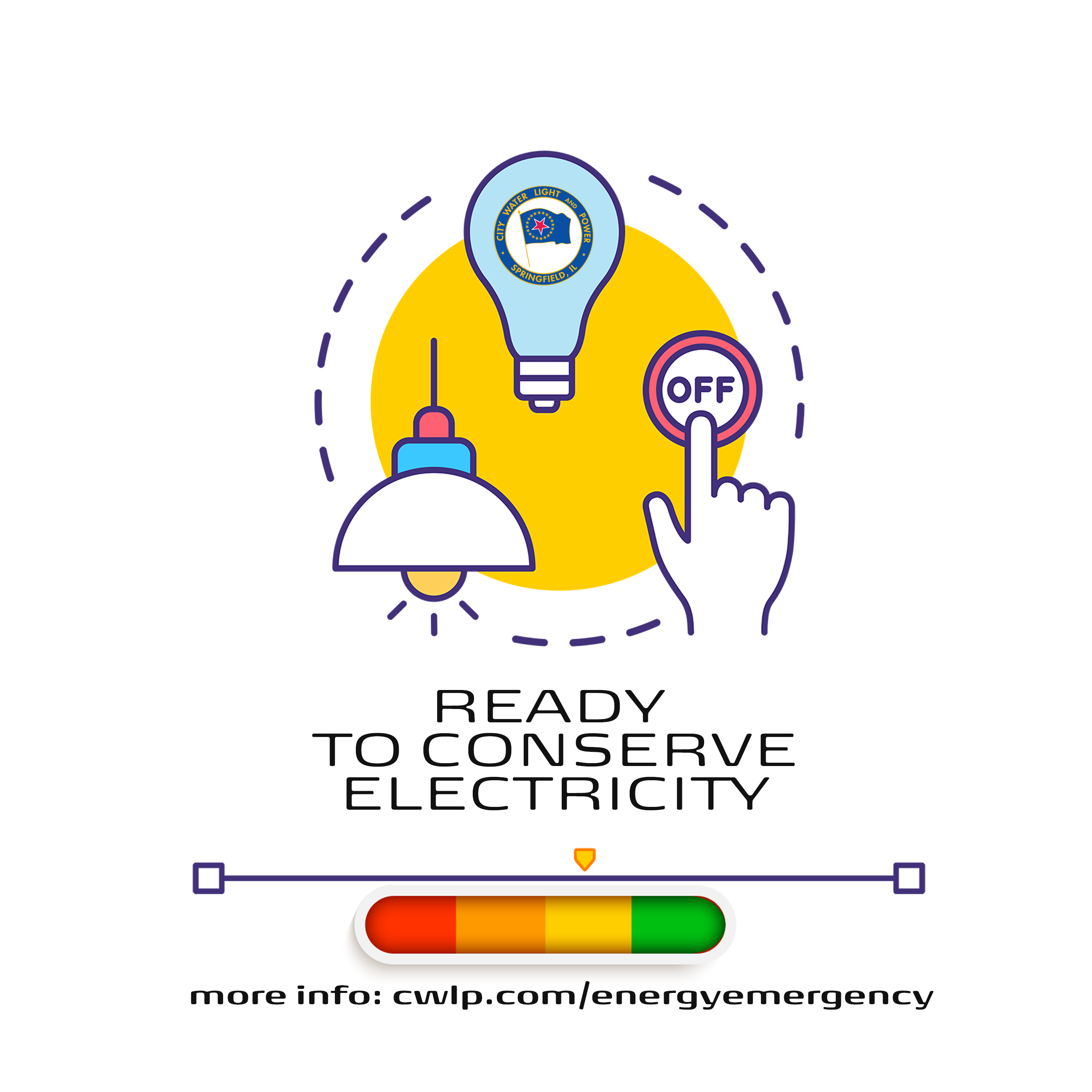
Before getting to the emergency level of needing rolling blackouts, CWLP may issue a Conservation Watch (Yellow) is an advisory CWLP could issue to prepare customers there may be a need to reduce electric usage. The next level up would be to issue a Conservation Warning (Orange) to ask its customers, if health and safety isn’t of concern, to begin reducing electric usage during particular high electric usage hours or when a lack of generation or transmission constraints exist on the Midwest energy grid.

Watch
Warning


General Year Round Measures
• Turn off lights where not needed.
• Postpone major appliance use, such as with washing machines, dryers and dishwashers.
• Turn off and disconnect electronics not in use such as computers, printers, copiers, coffee makers, televisions and charging devices.
• Turn off the circuit breakers for all electric water heaters. The water in the tank will remain hot for hours and the breaker can be turned back on later when reheating is necessary.
• Postpone any laundry and dishwasher use where possible.
• Turn off any stand-alone dehumidifiers, at the source or by circuit breaker.
• Reduce lighting for showroom displays and exterior signage wherever possible.
• Shut down all non-essential pumps, motors, processes, etc. and/or facilities where possible.
• Unplug or turn the power off to water fountains that dispense chilled water. Most fountains will still dispense water without power.

Cooling Season Measures
• Set thermostat to 78 degrees or higher
• Use floor or ceiling fans to cool off in occupied rooms
• In larger buildings, increase chilled water supply temperature by up to five degrees.
• Shade west-facing windows in the afternoon to reduce solar heat gain.

Heating Season Measures
• Turn off all electric heaters where possible.
• For electrically heated buildings, decrease interior temperature settings to 68 degrees or more, if possible.
• Allow direct sunlight to enter windows to increase solar heat gain in the building.

CWLP Advisory Levels Read More   

Steps Before Protective Power Outages Read More   

During regional grid emergency MISO and its member utilities take a number of steps to avoid rolling blackouts:
• Import Energy
• Delay Maintenance, Add All Available Generation
• Bring Peakers Online
• Issue Public Appeals to Voluntarily Conserve
• Last Resort—Implement Protective Power Outages (Rolling Blackouts)

How would CWLP implement Protective Power Outages? Read More   

As a last resort, in a regional energy emergency, if conservation steps and adding generation aren’t successful, CWLP and other MISO-member utilities in impacted zones would be required to shed load or implement rolling blackouts, which are essentially temporary, protective power outages across the grid. Protective power outages are critical during energy emergencies to avert strain on the electric system, which if not addressed could cause total blackouts and electric system damage with much more severe consequences as well as longer outage durations.

This would be done at the direction of MISO to all impacted utilities. By CWLP’s electric system design, the utility can implement these outages in approximately 15 minute increments, rotating across different circuits of the city at different times.

CWLP will issue public advisories on Protective Power Outages, known as Rolling Blackouts, to the local news media, various customer notifications and social media in the event of an energy emergency.

Rolling Blackout

Power Outage Safety Read More   

Typically a rolling blackout in 15 minute increments is more of an inconvenience than a large problem for most customers. As with any power outage, it helps to be prepared with the right supplies or critical backups you may need, and know what to do to keep yourself and your family safe and comfortable. Customers should update their contact information on file with CWLP Customer Service at 217.789.2030 or by email at cwlp.customer@cwlp.com. This ensures any customer outage notifications and CWLP Outage Map (https://outagemap.cwlp.com/) updates will correspond to their correct phone numbers and emails with street address. CWLP Social Media accounts on Facebook (https://www.facebook.com/4CWLP) and Twitter (https://twitter.com/CWLP_) generally provide power outage status and updates customers can also follow.

Here are some tips for power outages:
• Ahead of planned power outages, charge mobile phones and have portable batteries, laptops and other important devices charged up.
• Turn off or disconnect appliances and other equipment without surge protection.
• Avoid unnecessary travel, especially by car. Drive with caution as traffic lights may be out. All traffic lights out or on a flash should be treated as a stop sign.
• Follow CWLP Outage Map, Facebook and Twitter accounts for updates on large outages.

Safety During Longer Power Outages:
• Have a power outage emergency kit with battery powered radio, flashlights, portable chargers for phones, and first aid and food and water supplies.
• Keep refrigerator and freezer doors closed as much as possible.
• Have a plan for an alternate location to go.
• Know how to operate garage door manually.
• Keep vehicle gas tanks at least half full.
• If you rely on electric or battery-dependent medical technologies or have medications that require refrigeration, consider a backup power source. Consider your energy needs, fuel options and installation requirements when deciding on a backup power source for your home.
• Never run a portable generator inside a home or garage or plug directly into a home outlet or electrical system. Standby generators connected to your property’s electrical system should have a transfer safety switch installed by a professional.

Why Is Midwest Facing Energy Emergencies? Read More   

Regional Energy Emergency risks became pertinent when MISO and other regional grid operators announced risks for rolling blackouts due to projected energy shortfalls. Rolling blackouts are temporary controlled power outages or protective power outages that are phased in over areas to get electric demand to meet the generation resources available to ensure the integrity of the grid and not cause an imbalance, which could lead to total blackouts.

In a regional energy emergency, CWLP and other MISO member utilities would begin with internal conservation measures, bring on peaking units and other resources as possible, and then make public appeals for their customers to take steps to conserve electricity in order to avoid rolling blackouts, which are always a last resort.

FAQS Read More   

What are rolling blackouts or protective power outages?
In a regional energy emergency and as a last resort, if conservation and other load reducing measures to relieve stress on the electric grid aren’t successful, CWLP and other MISO-member utilities would implement rolling blackouts as protective power outages to avert total blackouts. This would be done at the direction of MISO to all impacted utilities. Read more about MISO’s Energy Emergency Procedures here. By CWLP’s electric system design, the utility can implement these outages in approximately 15 minute increments, rotating across different circuits of the city at different times.

Could CWLP Disconnect From The Grid To Avoid Blackouts?
No, CWLP is part of the regional electric grid. If disconnected from grid, CWLP would lose the ability to import electricity, which would cause total or partial blackouts anytime Dallman 4 needs to come offline or demand exceeds the electricity that can be supplied.

What Are CWLP’s Resources For Peak Demand or High Energy Use?
CWLP’s generation resources include Dallman Unit 4 (210 MW max) and the utility’s peaking units known as Interstate, Factory and Reynolds (144 MW max). Transmission upgrades completed in 2021 improved CWLP’s ability to import power upon the retirement of Dallman Unit 33.

Could Older Dallman Units or Adding More CWLP Generation Avert Blackouts?
No the older units coming back online would be cost prohibitive due to environmental regulations and would not help avert the need for rolling blackouts, which are the result of a regional grid issue that goes beyond Springfield’s borders. Due to the nature of an electric grid being interconnected, rolling blackouts, also known as protective power outages, are critical during energy emergencies to avert strain on the electric system and balance the electric grid.

Login to myCWLP


Register Forgot Password

City of Springfield

City of Springfield Home

Quick Links

  • Report a Problem
  • Make a Payment
  • About CWLP
  • Contact Us
  • Terms and Conditions

Stay Connected

  • Facebook
  • X
  • Instagram

© 2017 City Water, Light & Power, Information Systems Division